
When an overhead conductor comes down — brought by a storm, a vehicle strike or a failed pole — most people's instinct is to get away from it as fast as they can. On an energised line, that instinct is the thing most likely to hurt them.
The ground becomes the hazard
Electricity leaving a fallen conductor does not stop at the point of contact. It spreads outwards through the soil, and as it spreads it loses voltage. Picture rings on a pond: the ground immediately at the conductor sits at close to full line voltage, and each ring further out sits a little lower, until the potential fades to nothing some distance away.
That gradient is the hazard. Nothing has to be touched for someone to be injured.
Why the size of your stride matters
Current needs a difference in potential to flow. If both of your feet are on ground at the same voltage, there is nothing to drive current through you. If one foot lands on a ring at a much higher potential than the other, the difference appears across your body — up one leg and down the other.
This is step potential, usually shortened to step voltage. The longer the stride, the greater the difference between the two feet, and the more current is driven through the lower body. Running is simply the longest stride a person can take, repeated quickly, in exactly the wrong place.
Moving away safely
The technique taught on our electrical safety programmes is deliberately undramatic:
- Do not run, and do not take normal walking steps.
- Keep your feet in contact with each other and shuffle — move one foot a few centimetres, bring the other up to meet it, repeat. The feet stay close, so the potential across them stays small.
- Or hop with both feet together, landing on both at once, so both feet are always on the same ring.
- Keep going until you are well clear, not just a few paces. The gradient extends further than most people expect, and it is not visible.
If you are in a vehicle when a line comes down on it, the safest place is usually inside the vehicle. Stay there, call for help, and wait for the supply authority — unless fire forces you out, in which case the correct exit is a clean jump landing on both feet together, touching the vehicle and the ground at no point simultaneously, followed by the same shuffle or hop away.
What to do about the line itself
Nothing. There is no safe way for an untrained person to move, cover or test a fallen conductor.
- Assume it is live, including after an audible bang or a visible flash. Automatic reclosers can re-energise a line without warning.
- Keep everyone back and establish a wide cordon. Bystanders walk into gradients while looking at the conductor rather than at their feet.
- Watch for conductive paths — wet ground, puddles, metal fencing and wire ropes carry the potential further than dry earth.
- Call the supply authority and emergency services, and treat the area as energised until a competent person confirms isolation and earthing.
Why it is worth rehearsing
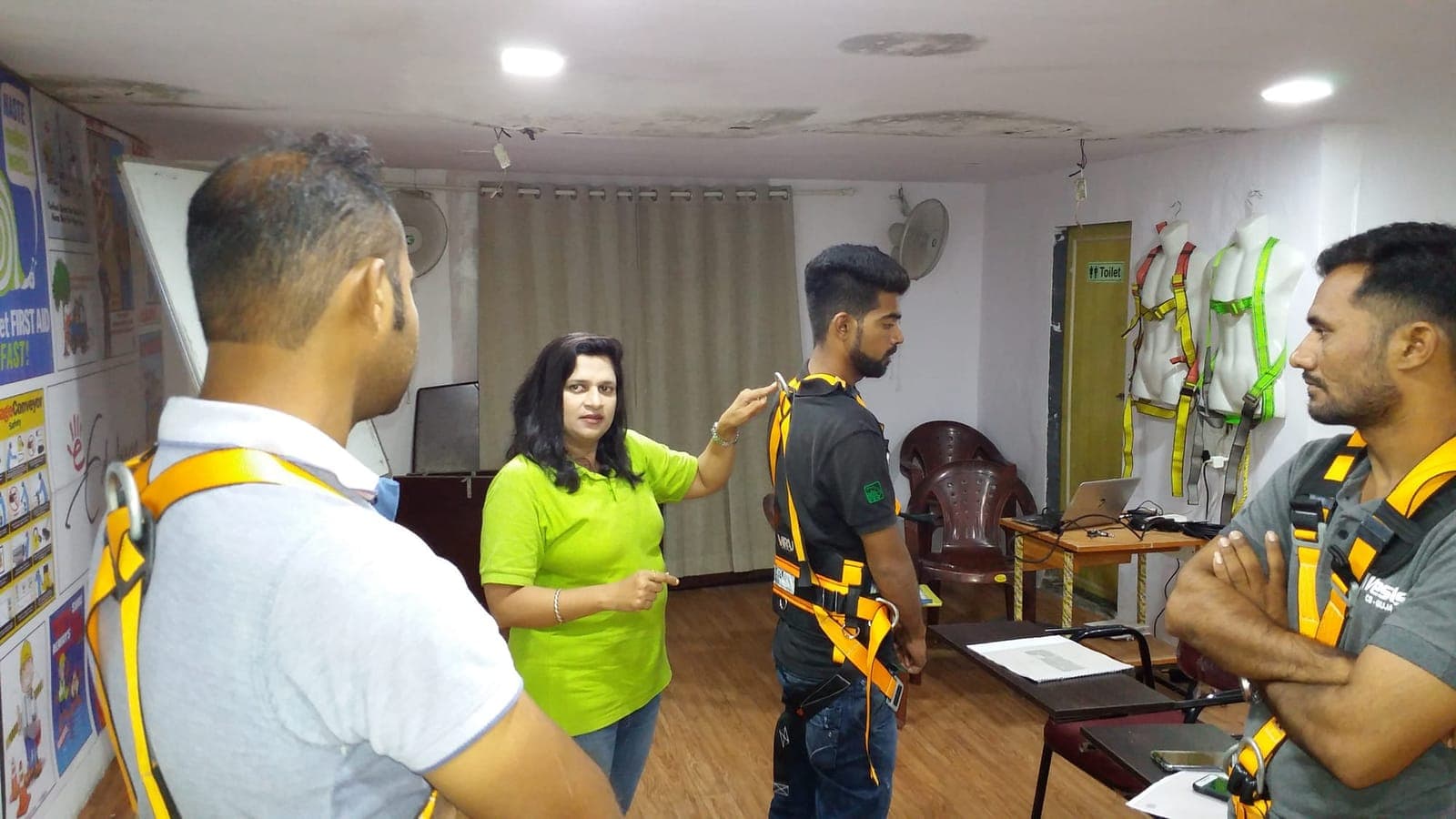
Step voltage is unlike most electrical hazards because there is no equipment to inspect, no lock to apply and nothing to switch off. Everything depends on what people do in the first few seconds, which is why it belongs in a briefing rather than a manual — and why it is practised on our electrical safety training rather than only described.
Content adapted from Eduforce's related safety and training publications.
Related training
Need help developing workplace safety capability?
Talk to Eduforce about training, consultancy and safety solutions.
Rakesh Temkar
Author
Writes on first aid, health and workplace safety for Eduforce.