
GWO Basic Safety Training (BST)
The foundation safety programme for personnel working in wind energy environments.
The Training
Training overview
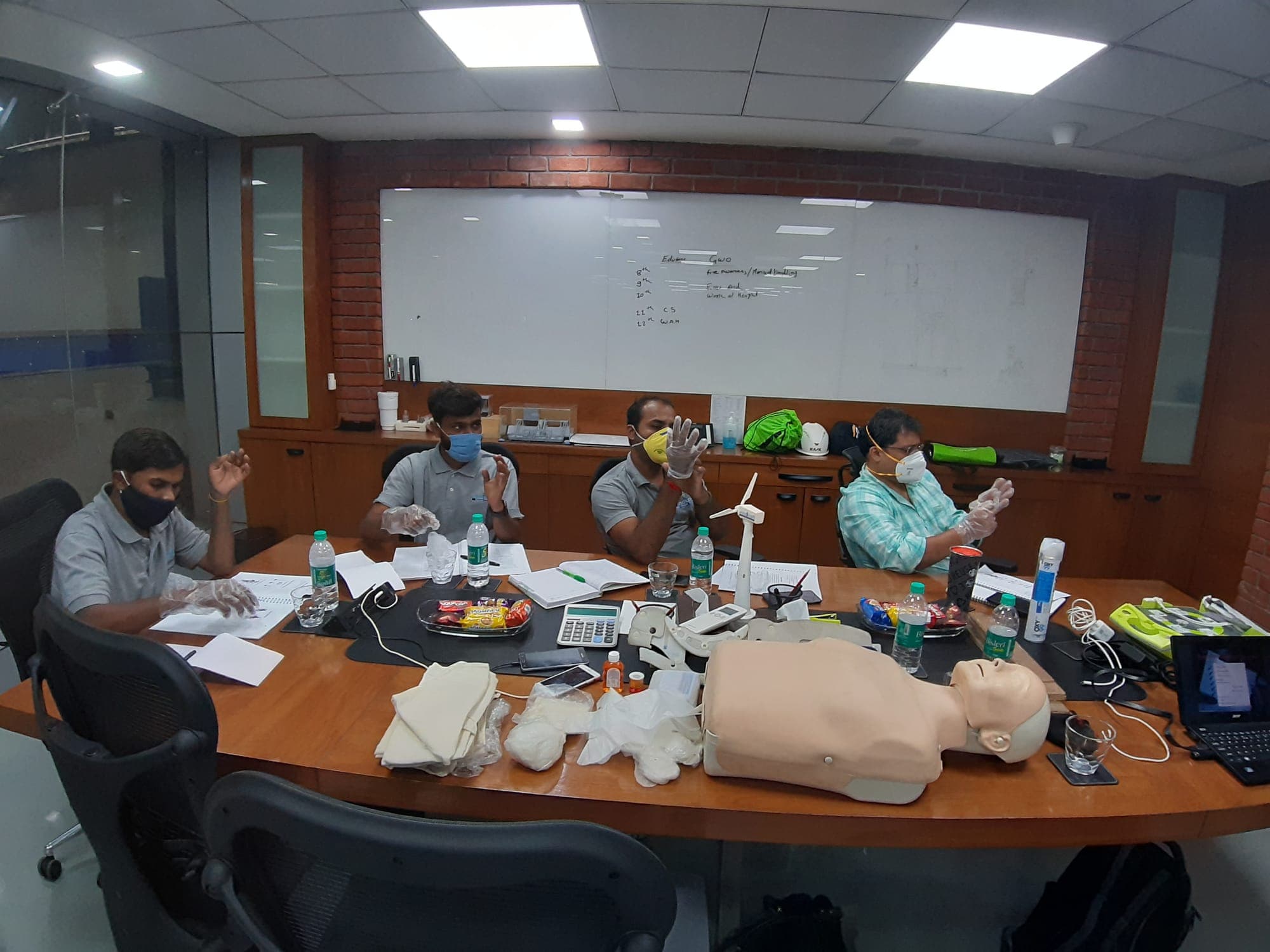
Basic Safety Training is the entry point of the GWO wind portfolio and the qualification most wind sites treat as non-negotiable. Across five modules it builds the safety behaviours a technician relies on daily — giving first aid in a remote location, moving safely at height and rescuing a colleague who cannot descend, handling loads correctly in confined spaces, reacting to fire inside a turbine, and, for offshore roles, surviving in water and transferring safely between vessel and structure.
Each module is taught as a mix of theory and supervised practical work, with scenario exercises drawn from real wind industry incidents. Theory is delivered at a maximum instructor-to-participant ratio of 1:12 and practical work at 1:6, so every participant is directly observed while performing the skills rather than simply watching a demonstration.
Modules can be taken individually where a risk assessment identifies the need, or as the full programme. Onshore roles typically take First Aid, Manual Handling, Fire Awareness and Working at Height; Sea Survival is added for offshore work.
Why this training matters
A wind turbine is a confined, elevated workplace, often far from emergency services. The people best placed to act in the first minutes of an incident are the technicians already on site. Basic Safety Training exists so that anyone working in that environment shares the same baseline of response — whatever their employer, and whichever site they mobilise to next.
What you will learn
- Recognise, assess and prioritise the need for first aid, and give lifesaving first aid until the casualty can be handed to the next level of care
- Work safely at height using fall-protection equipment, and rescue a suspended colleague
- Handle loads correctly in confined turbine spaces and recognise personal physical limits
- Prevent fire, recognise its early signs, and use turbine firefighting equipment correctly
- For offshore roles, survive cold-water immersion and transfer safely between vessel and turbine
- Recognise the limits of your own training, call for help and enable evacuation
Training pathways
Initial Training
The full programme, covering each module from the ground up for people new to the wind industry or requiring foundation safety training.
Refresher / Renewal
In transitionShorter refresher modules built around skill stations and industry-relevant scenarios, concentrating practice on the safety-critical skills used least often but needed most in an emergency. Participants must hold a valid initial or previous refresher training record to attend.
Duration: First Aid 4 h · Manual Handling 3 h · Fire Awareness 3 h · Working at Height 7 h 30 · Sea Survival 4 h 30
Training content
GWO BST First Aid (FA) Training
Recognising life-threatening situations and giving safe, effective first aid in a turbine environment.
7 hours
View ModuleGWO BST Manual Handling (MH) Training
Safe handling technique for the confined, awkward spaces of a wind turbine.
3 hours 45 minutes
View ModuleGWO BST Fire Awareness (FAW) Training
Fire prevention, extinguishing methods and emergency response inside a wind turbine.
3 hours 20 minutes
View ModuleGWO BST Working at Heights (WAH) Training
Fall prevention, fall arrest, personal fall protective equipment and rescue from height.
14 hours 15 minutes
View ModuleGWO BST Sea Survival (SS) Training
Offshore preparation covering cold-water immersion, life-saving appliances and safe transfer.
7 hours 25 minutes
View ModuleKey knowledge
- Primary survey methodology and the CAB-C structure for a casualty
- The legislation and regulatory framework governing work at height and fire safety
- How fire starts and spreads, and which extinguishing method suits which fire
- Manual handling injury patterns, symptoms and the principles that prevent them
- Cold-water immersion physiology and the body's survival responses
- Suspension trauma, dropped-object hazards and turbine-specific risks
Practical skills
- Performing CPR, controlling bleeding and treating burns, fractures and shock
- Fitting and inspecting a harness, and using lanyards, self-retracting lifelines and vertical fall arrest systems
- Rescuing and lowering a suspended casualty using rescue devices and rigging
- Operating turbine firefighting equipment in scenario exercises
- Righting a life raft and evacuating a crew transfer vessel by entering the water from height
Safety and risk awareness
- Suspension trauma following a fall arrest, and the need for prompt rescue
- Dropped objects in and around the turbine structure
- Fire behaviour in the confined, cable-dense spaces of a nacelle and tower
- Musculoskeletal injury from handling loads in restricted positions
- Cold-water immersion and the hazards of vessel-to-turbine transfer
Competencies
- Act independently in recognising, assessing and prioritising the need for basic first aid
- Use personal fall protective equipment correctly and inspect it before use
- Carry out evacuation and rescue from a turbine structure
- Respond correctly to a fire in a wind turbine
- Take responsibility for recognising your limitations and calling for help
Key learning outcomes
- Emergency response and evacuation
- Rescue from height
- Safe use of personal protective equipment
- Hazard identification in turbine environments
- Offshore survival and transfer
Assessment
Ongoing assessment throughout the course, recorded on the GWO Participant Performance Assessment form. Practical work is delivered at a 1:6 instructor-to-participant ratio so each participant is directly observed.
Practical training
Every module pairs classroom theory with hands-on exercises and scenario training, so participants rehearse the response under observation rather than only learning about it.
Important information
- Maximum 8 contact hours per training day.
- Instructor-to-participant ratio of 1:12 for theory and 1:6 for practical work.
- In version 20 of the standard, righting a life raft and evacuating a crew transfer vessel by entering the water from height are performed by the participant.