
Drowning rarely looks the way people expect. It is usually quiet, it happens quickly, and it often occurs close to other people who do not realise anything is wrong until it is over.
It does not look like the films
Someone in difficulty in water generally cannot call out. The airway is at or below the surface for much of the time, and breathing takes priority over speech. The arms press down on the water instinctively rather than waving, and the body stays upright with little useful leg movement.
What to look for instead: a head low in the water with the mouth at surface level, head tilted back, eyes closed or glassy, hair over the face, a vertical body position, and no progress despite apparent effort. A person quietly doing nothing effective is the picture to act on.
The order of rescue
The single most important principle is that entering the water is the last option, not the first. Rescuers who swim to a struggling person account for a significant share of drowning casualties, because a person in difficulty will climb anything that floats — including you.
The sequence taught almost everywhere is:
- Reach. Lie down, brace yourself, and extend something — a pole, a branch, a towel, an oar. Keep your own centre of gravity low and behind the edge.
- Throw. Throw a buoyant object attached to a line where possible: a ring buoy, a rope, anything that floats. Aim beyond and drift it in rather than hitting the casualty.
- Row. Use a boat or board if one is available and you can handle it.
- Go. Enter the water only if you are trained, equipped, and there is no alternative — and take something buoyant with you so the casualty has something to hold other than you.
Call for help early in that sequence, not after it has failed.
Once the casualty is out
- Check response and breathing. If they are not breathing normally, start resuscitation immediately and send for emergency help.
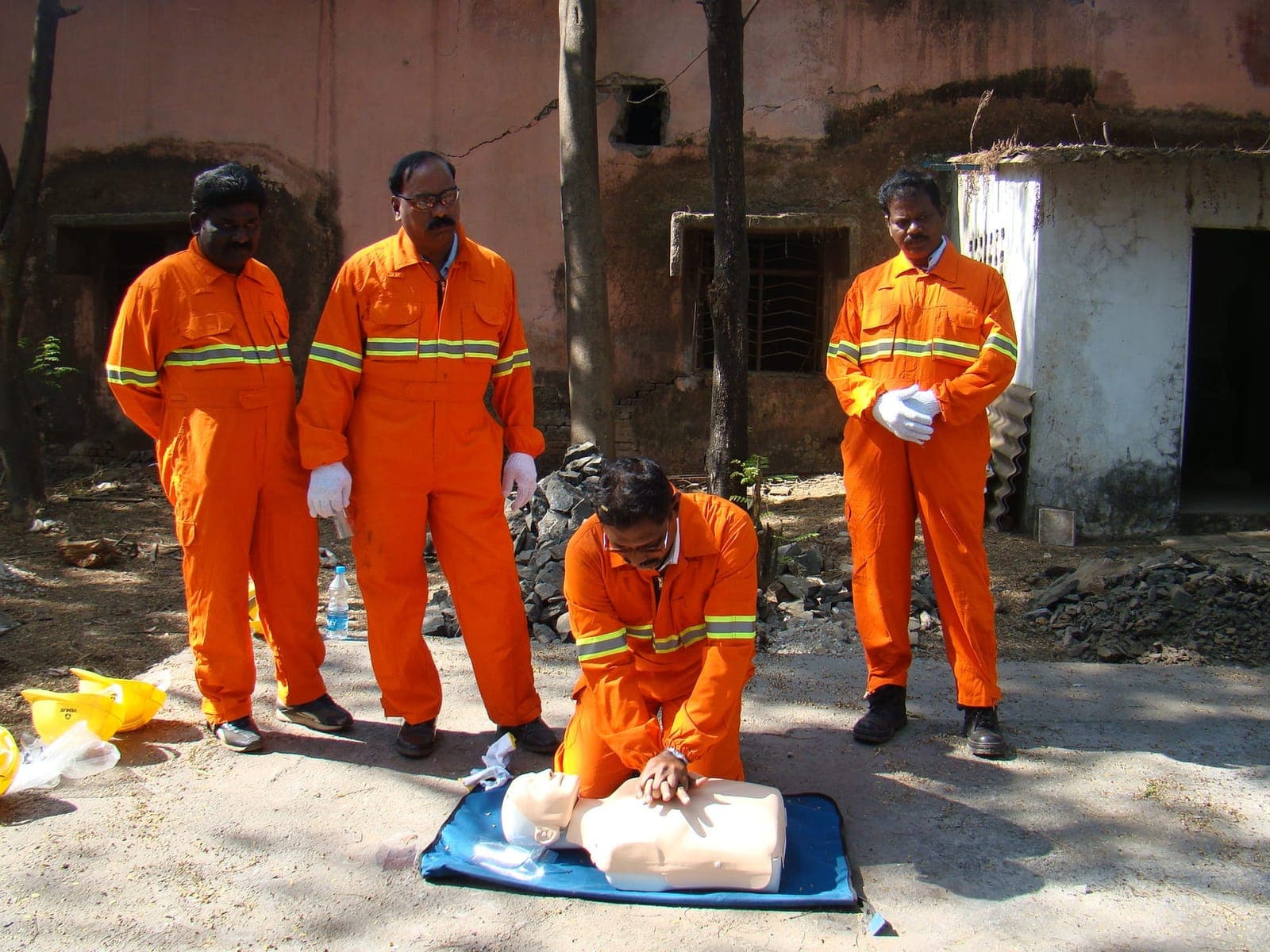
- Drowning is a hypoxic emergency, so trained responders give initial rescue breaths before compressions where they are able to. If you are untrained or unwilling to give breaths, chest compressions alone are far better than nothing.
- Do not waste time trying to drain water from the lungs. It does not work and delays what does.
- Keep them warm and get them assessed medically even if they seem to recover, because breathing problems can develop afterwards.
Prevention is the real control
Almost every drowning is preceded by something preventable:
- Barriers, covers and signage around open water, tanks and pits.
- Buoyancy aids worn where the risk requires them — worn, not stored.
- Rescue equipment positioned where an incident would happen, and people who know it is there.
- Supervision of children around water treated as a continuous task, not an occasional glance.
- Alcohol kept away from water activities.
- Attention paid to current, depth and temperature rather than to swimming confidence.
For sites and teams that work on or near water, this belongs in the emergency plan with named equipment and named responders. Our first aid programmes cover resuscitation, and GWO Sea Survival covers the water-specific skills for the offshore and marine environment.
Content adapted from Eduforce's related safety and training publications.
Related training
Need help developing workplace safety capability?
Talk to Eduforce about training, consultancy and safety solutions.
Rakesh Temkar
Author
Writes on first aid, health and workplace safety for Eduforce.