
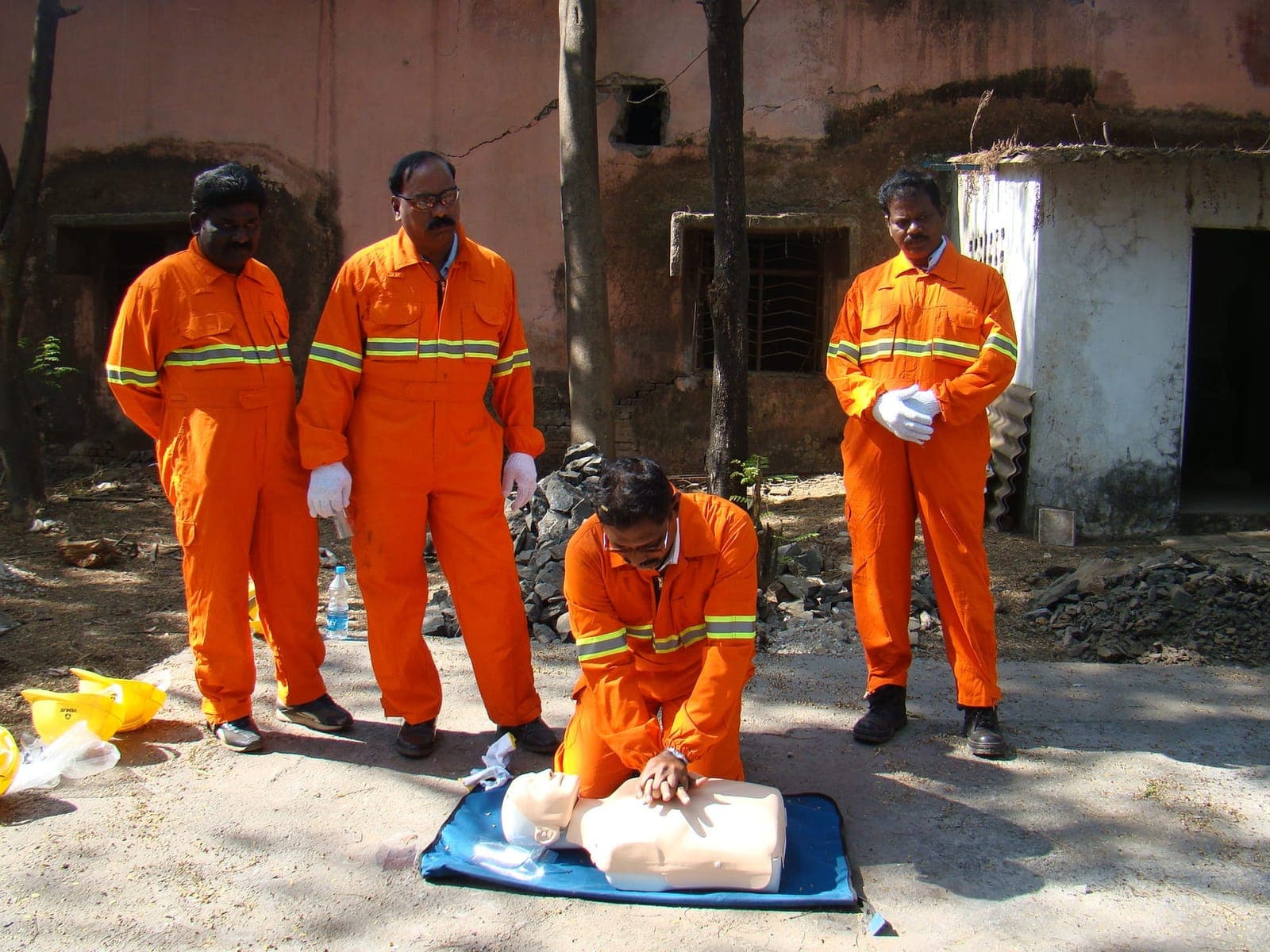
Ask most site managers about first aid and they will point to the green box on the wall. It is well stocked, it is inspected, and there is a poster beside it. It is also almost irrelevant to the two situations that decide whether someone goes home: cardiac arrest and severe bleeding.
In both, the outcome is decided in the first ten minutes — usually before any ambulance arrives — by whoever is standing nearest.
Cardiac arrest: every minute without CPR costs about 10%
When the heart stops, the brain has roughly four minutes before damage begins. Survival falls by around 7–10% for every minute without CPR and defibrillation. In most Indian industrial settings the realistic ambulance response time is far longer than that.
The chain of survival is short and every link is a person on site:
- Recognise it — unresponsive and not breathing normally. Gasping is not breathing.
- Call for help — the site emergency number and an ambulance, and send someone for the AED.
- Compress — hard and fast in the centre of the chest, 100–120 per minute, at least 5 cm deep, letting the chest fully recoil. If you are trained and willing, 30 compressions to 2 breaths.
- Defibrillate — switch on the AED and do what it says. It will not shock a heart that does not need it.
- Hand over — to the ambulance crew, without stopping compressions until they take over.
None of this requires the first aid box. It requires a person who has practised it on a manikin until it is automatic, and an AED that is where the sign says it is and has a charged battery and in-date pads.
Severe bleeding: pressure beats everything in the kit
A person can lose a fatal volume of blood from a major limb wound in a few minutes. The intervention is not a dressing selected from the box; it is direct, firm, sustained pressure on the wound, applied immediately, with whatever is to hand, and a tourniquet high on the limb if pressure cannot control it. Tourniquets are back in mainstream first aid guidance for exactly this reason — and using one well takes practice.
What "trained" actually means
A certificate on the wall from three years ago does not mean a trained first aider is on site today. Trained means:
- Enough of them — on every shift, in every area, including nights and weekends. One first aider in the admin block does not cover the plant at 2 a.m.
- Recent — skills fade in months. Refresher practice at least annually, and a full requalification within the certificate's validity.
- Practised on the real risks — a chemical plant's first aiders need to know their chemicals; a wind site's need to know how to reach a casualty in a nacelle.
- Known — everyone on site can name the nearest first aider and find the nearest AED without looking it up.
The plan behind the person
First aid works inside an emergency plan, not instead of one. The plan answers:
- How is help summoned, and does the phone in the workshop actually reach the emergency number?
- Who meets the ambulance at the gate and guides it to the casualty?
- Where is the casualty going — which hospital, how far, and is the route known?
- For remote or elevated locations, how is the casualty reached and moved? This is where first aid meets rescue, and why our Rescue and Medical Specialists programme exists.
Where to start
If your site's first aid provision is a box and a certificate, start with people: a First Aid with CPR programme for enough staff to cover every shift, an AED in every area more than three minutes from the next one, and a drill that tests whether the plan works on a Sunday night.
Then keep the box stocked. It matters — just not first.
Related training
Need help developing workplace safety capability?
Talk to Eduforce about training, consultancy and safety solutions.

Dr. Mona Gandhi
Founder Director, Eduforce
A postgraduate in Emergency Medicine and an internationally certified trainer, described in the Eduforce brochure as a distinguished personality, a skilled educator and motivator, and a successful safety trainer over many years.
More about Dr.